
The patient’s timeline of care covers every step that a patient takes from the time their procedure is scheduled to the moment they make their final payment. Within this timeline, facilities typically utilize 5-7 different vendors ranging from patient intake, engagement, tray coordination for upcoming surgeries, and much more. Every touchpoint between the facility and the patient is a place where something critical could be overlooked. For example, an oversight in a high-risk patient’s health history, an instruction or a misunderstanding about their financial responsibility.
A good timeline of care is one where the patient never experiences any discourse. Nothing feels disconnected or late, and the case moves smoothly from scheduling to discharge to final payment.
So how do you build an experience like that? First, you must know what your ideal patient experience should look like and pay attention to any gaps that show up between intake, communication, clearances, post-op surveys, billing, etc. You also need to know what technology is needed to build this ideal timeline of care.
What does an ideal patient experience look like?
The patient’s timeline of care includes the clinical, administrative, and financial sequence from initial scheduling to final payment. One Mnet Health supports the patient experience through our connected solutions. But what does that experience look like to a patient?
- Patients know what’s coming before it happens. Arrival time, prep instructions, and what to expect is spelled out ahead of time, not discovered in the moment.
- The cost isn’t a surprise after surgery. Financial clarity several weeks out beats a surprise bill they were not expecting.
- Nobody asks the same question twice. The patient’s meds, allergies, and health history should already be in front of whoever’s seeing them next.
- High-Risk factors get flagged early, not in pre-op holding. Catching an A1C problem or a missed anticoagulant a week out saves a cancellation and a wasted operating room slot.
- The day-of-surgery feels tight and calm, not like a waiting-room marathon. Because staff are informed and move faster, patients can also move through their patient journey more quickly.
- Their healthcare provider checks on them after they go home. Within 24 – 72 hours, post-op check-ins can catch complications and signals of their recovery.
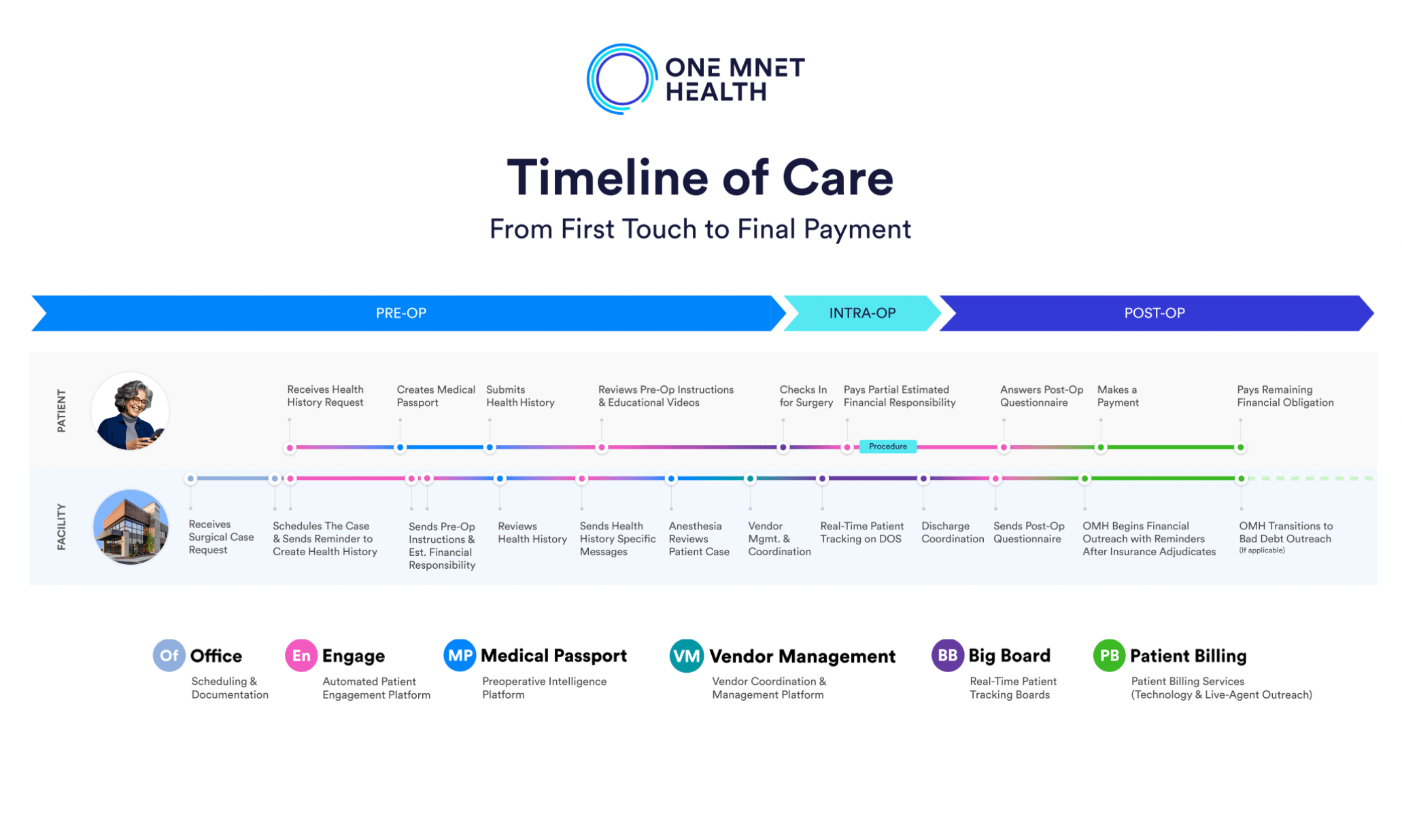
How One Mnet Health helps to optimize the patient experience
The patient’s timeline begins the moment a case is scheduled. Our patient engagement platform, Engage, sends the first message and asks the patient to create a Medical Passport, a digital online patient intake form. Medical Passport guides the patient through their health history on any device, in their own time, without paper forms in a waiting room. Once their health history is submitted, Engage delivers pre-op instructions in the patient’s preferred language, medication instructions, educational videos, and a clear estimate of financial responsibility, all before the patient arrives at the facility.
The patient also has the option to pay a portion of their estimated financial responsibility before surgery or browse payment options, including payment plans, that fit their financial situation. This sets the expectation early, removes any financial surprises, and reduces the amount owed after insurance adjudicates.
On the day of surgery, check-in moves fast because the health history, policies & disclosures, pre-op instructions, payment and contact information are verified and already in the system. After the procedure, Engage sends the post-op questionnaire and any condition-specific recovery instructions according to the automation rules the facility has set.
One Mnet Health’s Patient Billing team handles the remaining financial outreach through a mix of automated reminders and live-agent outreach which starts the same day the claim is adjudicated rather than weeks later.
What most people don’t see: the system behind the patient experience
Facilities get excited about this ideal patient experience scenario, and rightly so. But what does it take to actually deliver it? Simply put, the facility needs the right tools at the right time, before the patient ever notices a gap.
This is where our solutions come in. We capture the surgical case request details to help the facility schedule it through our product called Office. Engage immediately starts the patient communication sequence, which means the clinical team is not chasing patients for health histories or sending one-off reminders. Medical Passport collects the health history and processes it automatically, which is where the smart automation begins.
With Medical Passport’s Admission Guidelines capabilities, facilities receive guideline-driven recommendations according to their own admission criteria regarding additional clearances, labs, imaging, or anesthesia consults the patient may need before their procedure.
By transforming this data into actionable insights and intelligence, care teams can make more informed and confident clinical decisions, improve patient outcomes, and boost patient satisfaction.
Because Medical Passport captures in-depth patient data, personalized messages can easily be automated. For example: a patient with diabetes, a patient taking anticoagulants, and a patient with sleep apnea each receive different pre-op messaging. Anesthesia then reviews the case with the full health history already organized, and risk factors flagged. Pre-op nurses do not have to worry about calling patients to confirm NPO status, medication holds, or transportation arrangements because the system has already done it.
Vendor Management coordinates implants, reps, and trays so cases are not delayed on the day of surgery. Our real-time patient tracking board, Big Board, tracks every patient in real time and gives the charge nurse, surgeons, family communication staff, and PACU the same view of where each case stands. By the end of the procedure, discharge coordination is already handled, and the patient is ready to be handed to their ride-home.
After surgery, Engage collects post-op questionnaires and patient-reported outcomes. Our Patient Billing team takes over financial outreach as soon as insurance adjudicates, which accelerates patient payments and increases collection rates by a minimum of 40%.
The clinical team’s time shifts from data collection to decision-making. The patient receives communication that feels personal because it is. Both sides of the timeline benefit from the same underlying intelligence.
Why the clinical and financial touchpoints matter
Every touchpoint on this timeline has both a clinical purpose and a financial one. When either side breaks down, the patient feels it.
On the clinical side, every interaction is an opportunity to prepare the patient for a safe, successful procedure.
Health histories, personalized instructions, risk identification, and timely reminders help care teams make informed decisions, reduce delays, and keep cases on schedule.
On the financial side, these same moments are opportunities to create better outcomes for the organization. A patient who receives a clear estimate before surgery is more prepared to pay their estimated financial responsibility. And when a patient pays part of their balance before their procedure, their remaining balance is addressed once insurance adjudication has taken place. This helps facilities to boost cashflow, accelerate patient payments, and reduce bad debt, while improving patient satisfaction.
Together, these touchpoints create a smoother experience for patients and a more efficient workflow for providers.
FAQs
What is the timeline of care in an ambulatory surgery center?
The timeline of care is the connected sequence of clinical, administrative, and financial events that a patient’s surgical case moves through from scheduling to final payment. It includes pre-op preparation, intra-op coordination, and post-op recovery and billing.
How does One Mnet Health enhance the patient experience across the timeline of care?
One Mnet Health uses Engage to deliver personalized pre-op and post-op communication through the power of automation, Medical Passport to collect health histories and personalize clinical workflows, and Patient Billing to handle financial outreach.
How does One Mnet Health improve efficiency for providers and clinical teams?
Medical Passport digests patient health histories automatically and triggers downstream communication, anesthesia review, and pre-op preparation without manual intervention. Office, Vendor Management, and Big Board coordinate scheduling, vendor logistics, and real-time case tracking. Patient Billing manages financial outreach after insurance adjudicates in order to accelerate patient payments.
What is smart automation in the timeline of care?
Smart automation in the timeline of care transforms patient health history data into actionable insights and intelligence that enable more informed and confident clinical decisions.